North Head at the entrance to Sydney Harbour is a beautiful and haunting place and with its own micro climate it seems far more remote than it actually is, lying just a few kilometres from the centre of Sydney.
It’s a place I visit a lot… running or riding along the trails an through the historic buildings of North Fort and the old Quarantine Station.
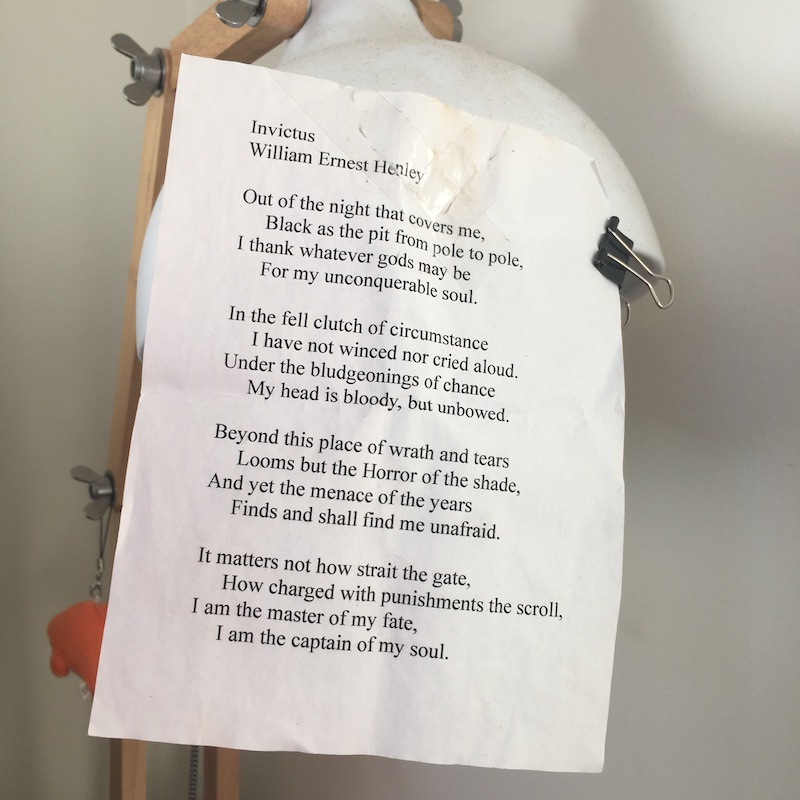
Anyway, one day I was up there running in the rain and saw a damp and tattered piece of paper hanging from a tree by a bulldog clip. It was a print out of “Invictus”, a poem penned by William Ernest Henley back in 1875.
Now I don’t know who left it there, or why, but it now hangs beside my desk for me to see, and it gives me inspiration everyday in many aspects of my life.
Here it is and I’ll run through some of my thoughts on how you may be able to draw strength from this poem as you face the challenges that may cross your path on your journey though mountain biking and through life.
Out of the night that covers me,
Black as the pit from pole to pole,
I thank whatever gods may be
For my unconquerable soul.
In the fell clutch of circumstance
I have not winced nor cried aloud.
Under the bludgeonings of chance
My head is bloody, but unbowed.
Beyond this place of wrath and tears
Looms but the Horror of the shade,
And yet the menace of the years
Finds and shall find me unafraid.
It matters not how strait the gate,
How charged with punishments the scroll,
I am the master of my fate,
I am the captain of my soul.
The word "invictus" itself means "unconquerable" in Latin, signifying the indomitable spirit that lies within each one of us. It’s perhaps best known for being the poem that Nelson Mandela used to recite to his fellow prisoners in Robben Island.
Many people think the poem is about war or social struggle. But it actually originated from a hospital bed. It’s about Henely’s battles with illness and everyday strife.
Henley was a poet, which is historically a tough way to earn a crust. He inspiration was his own struggle through tuberculosis, an amputated leg, and financial issues. One of his friends was Robert Louis Stevenson, author of Treasure Island, and he loosely based the character Long John Silver on his bearded mate Henley, who hobbled around on one leg and a crutch.
In "Invictus," he portrays a narrator who refuses to surrender to challenges and instead draws inspiration from them. H
The poem is a masterclass in grit. And while we choose our suffering in the woods voluntarily, the physical and mental parallels to our sport are striking.
Here is what mountain bikers can learn from Invictus about mastering the trail, our bodies, and our minds.
"Under the bludgeonings of chance / My head is bloody, but unbowed."
Mountain biking is a sport of extreme unpredictability. You can have your suspension dialed, your nutrition perfect, and your fitness peaking, only to have a jagged rock slice your sidewall three miles from the car. The weather turns, a pedal strikes a hidden root, or a slick off-camber section sends you over the bars.
Henley calls these the "bludgeonings of chance"—the chaotic, uncontrollable blows life (or the trail) deals you. When things go wrong in the backcountry, the mental test begins. You can throw your bike, curse the trail builders, and let the frustration ruin your ride. Or, you can patch the tire, shake off the dirt, and keep moving. Being "unbowed" doesn't mean you don't crash; it means you refuse to let the crash dictate your attitude.
"Out of the night that covers me, / Black as the pit from pole to pole..."
Every endurance athlete knows "the dark place." In mountain biking, you usually find it on a grueling, seemingly endless fire-road climb in the middle of summer, or halfway through a marathon cross-country race when your glycogen is depleted and your legs are screaming.
It feels inescapable. The physical discomfort translates directly into mental darkness. Your brain begs you to unclip, to walk, to turn around. Invictus teaches us that this darkness is a space to be endured, not feared. The ability to sit in that discomfort, maintain a steady cadence, and breathe through the suffering builds a psychological callus. The more you visit the pit and pedal your way out of it, the less power it has over you on the next ride.
"In the fell clutch of circumstance / I have not winced nor cried aloud."
Let’s be honest: mountain biking hurts. Even on a good day, your forearms pump, your lungs burn, and your lower back aches. On a bad day, you're dealing with bruised ribs, scraped knees, or separated shoulders.
While crying aloud is perfectly acceptable when you break a collarbone, the broader lesson here is about our relationship to physical pain and fear. Progression in this sport requires managing fear—committing to a steep drop, holding speed through a rock garden, or trusting your tires in loose corners. When we tense up ("wince"), we crash. When we stay loose, accept the terrain, and ride with quiet resolve, the bike does what it’s meant to do.
"I am the master of my fate: / I am the captain of my soul."
This famous closing couplet is the ultimate mountain biking truth. When you are rolling down a singletrack, nobody else can ride the bike for you. You can watch tutorials, buy the best gear, and follow the fastest local rider, but the execution is entirely on your shoulders.
This total accountability is why mountain biking is so incredibly good for our mental health. In a modern world where we often feel like passengers in our own lives, the bike forces us back into the driver's seat. You choose the line. You modulate the brakes. You provide the power.
Every time you conquer a feature that once terrified you, or finish a loop you thought was beyond your fitness, you are reinforcing a powerful internal narrative: I am capable. I am in control.
The trail will always throw roots, rocks, and ruin at you. But as long as you keep your hands on the bars and your eyes down the trail, you are the captain of the ride.